
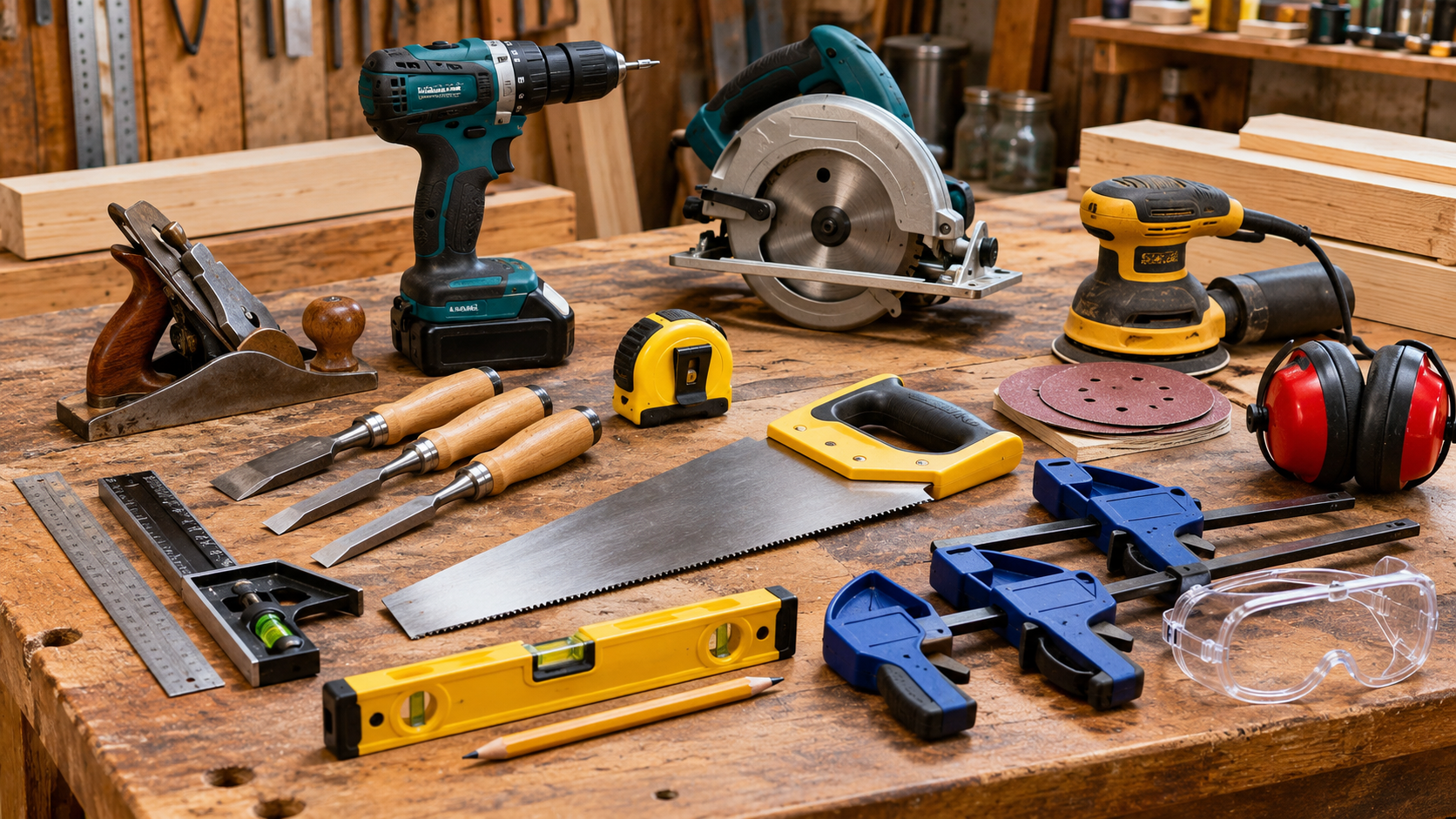
Setting up your first woodworking workshop can be exciting, but choosing the right tools isn’t always straightforward. With so many hand tools, power tools and accessories available, it’s easy to buy equipment you don’t need. You might be planning to build furniture, complete home improvement projects or take up woodworking as a hobby. Whatever your goals, understanding which tools are essential will help you create a practical workshop. It will also prevent unnecessary spending.
This beginner-friendly guide explains which essential woodworking tools are worth buying. We’ll cover measuring, marking, cutting, drilling, shaping and sanding equipment. You’ll discover what each tool does and when it’s useful. We’ll also explain which purchases to prioritise when working with a limited budget. You’ll learn how to choose reliable equipment and organise a safe workspace. As your skills develop, you can gradually expand your tool collection to suit more ambitious projects.
Choosing the Right Tools for Your First Workshop
Before purchasing woodworking tools, consider the types of projects you want to complete and the space available in your workshop. Someone building small shelves or decorative items will have different requirements from someone making large tables, cabinets or fitted furniture. Starting with versatile tools that perform several tasks allows you to develop practical skills while keeping your initial investment manageable. As your experience grows, you can introduce more specialised equipment to suit increasingly demanding projects.
Quality is another important consideration when selecting woodworking equipment. Inexpensive tools can be suitable for occasional use. However, poorly manufactured equipment may produce inaccurate results, wear out quickly or become frustrating to operate. Look for tools with comfortable handles, dependable adjustment mechanisms and readily available replacement parts or accessories. Reading independent reviews and comparing specifications can help you identify reliable equipment. This approach offers better long-term value without automatically choosing the most expensive tools.
Workshop safety should also influence your purchasing decisions from the beginning. A stable workbench, suitable clamps, adequate lighting and appropriate personal protective equipment are just as important as saws, drills and sanders. Consider dust extraction, safe electrical connections and sufficient space to handle timber comfortably. By establishing good working habits and investing in essential safety equipment early, you can create a more efficient workshop while reducing avoidable risks as you learn new woodworking techniques.
Essential Measuring and Marking Tools for Woodworking
Accurate measuring and marking are fundamental to successful woodworking, regardless of the size or complexity of your project. Even small measurement errors can lead to poorly fitting joints, uneven surfaces and wasted materials. A reliable tape measure, steel rule, combination square and marking pencil should form part of every beginner’s toolkit. These simple tools help you establish accurate dimensions, check right angles and mark cutting lines before making permanent changes to your timber.
A tape measure is ideal for checking overall dimensions and measuring longer pieces of timber. For smaller components and detailed marking, a steel rule provides greater precision. A combination square is particularly useful for checking 90-degree and 45-degree angles. It can also mark parallel lines and verify that timber edges are square. Beginners may also benefit from a marking gauge. This tool produces consistent lines parallel to an edge when preparing joints or marking repeated cuts.
Developing accurate measuring habits is just as important as owning reliable equipment. Always work from a consistent reference edge, check measurements before cutting and use the same measuring tool whenever possible to avoid small differences between scales. A sharp pencil or marking knife can produce clear, precise layout lines, while a square helps transfer those lines accurately across adjoining surfaces. Taking a little extra time during preparation can significantly reduce mistakes, improve joint alignment and produce more professional-looking finished projects.

Essential Cutting Tools for Beginner Woodworkers
Cutting tools are essential equipment in any woodworking workshop. They allow you to prepare timber, shape components and create accurate parts for assembly. Beginners should choose tools suited to their materials and intended projects. There is no need to purchase several expensive machines immediately. A good-quality handsaw is useful for straightforward cuts and developing basic techniques. Circular saws and jigsaws can make larger cutting tasks quicker and more manageable. Choosing suitable cutting equipment depends on several factors. These include the required accuracy, available workspace and your confidence using different tools safely.
A handsaw is an excellent starting point for beginners. It is affordable, requires little maintenance and helps develop control over cutting techniques. A general-purpose crosscut saw can handle many everyday tasks. A tenon saw is useful for finer, more accurate cuts when making joints. For larger projects, a circular saw provides faster straight cuts through timber boards and sheet materials. Using a suitable guide can also improve cutting accuracy. However, circular saws require careful handling, secure workpiece support and appropriate safety precautions. Beginners should choose a model with effective blade guarding and follow the manufacturer’s operating instructions.
A jigsaw offers greater flexibility when cutting curves, irregular shapes and openings in timber or sheet materials. Its compact size makes it particularly useful for smaller workshops, although it is generally less suitable than a guided circular saw for producing long, consistently straight cuts. Blade selection is important, as different tooth patterns are designed for hardwood, softwood, plywood and other materials. For most beginners, a dependable handsaw combined with either a circular saw or jigsaw will provide enough cutting capability for a wide range of early projects. Additional machinery, such as a table saw or mitre saw, can be considered later when project requirements justify the investment. If you’re considering upgrading your workshop, our guide to selecting your first table saw explains the important features, safety considerations and buying decisions.

Essential Drilling and Driving Tools for Woodworking
A reliable cordless drill is one of the most useful power tools a beginner woodworker can own. It can drill holes, drive screws, assemble furniture and support a wide variety of workshop tasks without requiring a mains power connection. For most beginners, a variable-speed drill driver with adjustable torque settings provides an excellent balance of versatility, control and convenience. A keyless chuck makes changing drill bits straightforward, while a rechargeable lithium-ion battery allows you to work comfortably around the workshop. Unless you regularly need to drill into masonry, a dedicated drill driver may be sufficient without the additional hammer function of a combi drill. For more detailed advice on choosing the right model, read our guide to the best cordless drills for DIYers and professionals.
Choosing the correct drill bits is just as important as selecting a dependable drill. Brad-point bits are particularly useful for woodworking. Their pointed tips help position holes accurately and prevent the bit from wandering when drilling into timber. Twist drill bits are versatile for general tasks. Countersink bits create recesses that allow screw heads to sit flush with the wood surface. Beginners usually need only a small selection of commonly used sizes. Investing in good-quality bits can produce cleaner holes and more consistent results. This is often better than purchasing a large collection of inexpensive accessories.
Screwdriving accessories also deserve attention when assembling wooden furniture and workshop projects. A set of correctly sized screwdriver bits, a magnetic bit holder and a few manual screwdrivers will cover most fastening tasks. Using the correct bit reduces the risk of damaging screw heads. Adjustable clutch settings on a cordless drill help prevent overtightening and splitting timber. For greater accuracy, drill suitable pilot holes before inserting screws. This is particularly important near board edges or when working with dense hardwoods. An impact driver can be useful for demanding fastening work. However, most beginners can manage everyday woodworking tasks with a standard cordless drill driver.

Essential Hand Tools for Shaping and Joinery
Hand tools remain an essential part of woodworking, even in workshops equipped with modern power tools. They provide greater control when shaping timber, refining joints and completing detailed finishing work. A small selection of woodworking chisels, a dependable hand plane and a wooden or rubber mallet are useful for beginners. These tools help develop fundamental skills and make certain tasks easier to complete accurately. Learning to use them correctly also improves your understanding of timber grain and cutting direction. It also demonstrates the importance of maintaining sharp cutting edges.
Woodworking chisels are useful for cutting and refining joints. They also remove small amounts of material and clean up corners that power tools cannot easily reach.
Beginners can complete many common tasks with a small set of bevel-edge chisels in different widths. There is no need to purchase an extensive collection.
A wooden mallet provides controlled tapping when removing waste material. For delicate trimming work, careful hand pressure is often sufficient.. Always secure the timber firmly and keep your hands behind the cutting edge. Sharp, well-maintained chisels provide greater control and produce cleaner results than blunt tools that require excessive force.
A hand plane is another valuable tool for smoothing timber surfaces, adjusting board thickness and refining edges before assembly. A block plane is useful for trimming end grain, easing sharp corners and making small adjustments. A bench plane is better suited to flattening and straightening larger surfaces. Beginners should also consider a basic sharpening system. Suitable sharpening stones and a honing guide help maintain consistent cutting edges on chisels and plane irons. Learning to sharpen and adjust hand tools correctly improves accuracy and reduces unnecessary effort. Proper maintenance also extends the useful life of your equipment. To develop your woodworking skills further, explore our guide to essential joinery techniques. This guide explains practical methods for creating strong, accurate timber joints.

Essential Sanding and Finishing Tools for Woodworking
Sanding and surface preparation are essential stages of woodworking that influence both the appearance and durability of finished projects. Even carefully cut and assembled timber may contain rough areas, minor tool marks or uneven surfaces that need attention before applying a protective finish. Beginners should start with a selection of sandpaper in different grit sizes, a sanding block and suitable dust-removal equipment. A random orbital sander can also be a worthwhile investment for larger projects, helping produce smooth, consistent surfaces more efficiently than sanding entirely by hand.
Selecting the correct sandpaper grit is important for achieving a smooth, even surface without removing unnecessary material. Coarser abrasives, such as 80-grit paper, are useful for removing noticeable imperfections, while medium grits around 120 are suitable for general smoothing. Finer abrasives, including 180 and 220 grit, can help prepare timber for finishing, depending on the wood species and the finish being applied. Work progressively through suitable grit sizes rather than jumping directly from coarse to fine. A sanding block helps maintain flat surfaces when working by hand, while a random orbital sander provides efficient material removal across larger panels and furniture components.
Once sanding is complete, remove dust thoroughly before applying oils, waxes, stains or protective coatings. A vacuum with suitable filtration, clean brushes and lint-free cloths can help prepare surfaces for finishing. Beginners should choose finishing products based on the timber species and intended use. Always follow the manufacturer’s application instructions and test the finish on an offcut before treating the completed project. Adequate ventilation and appropriate protective equipment are essential when applying finishing products. Oily finishing cloths can pose a fire risk. Always handle and dispose of them according to the manufacturer’s fire-safety instructions. Good preparation and careful application will help produce attractive, durable results.

Essential Clamps and Workbench Equipment for Woodworking
A stable workbench and reliable clamps are fundamental to safe, accurate woodworking. Securing your workpiece is important when cutting timber, drilling holes, assembling furniture or applying glue. It helps prevent unwanted movement and allows you to concentrate on the task. Beginners do not need an expensive professional workbench. However, they should choose a sturdy working surface at a comfortable height. It should also provide sufficient space for their projects. Quick-release clamps, F-style clamps and longer bar clamps offer useful flexibility. They can hold smaller components, secure boards and support the assembly of larger furniture pieces.
Different types of clamps are designed for different woodworking tasks, so building a small, versatile collection is more useful than purchasing numerous identical clamps. Quick-release clamps are convenient for holding components temporarily, while F-style clamps provide adjustable pressure for general assembly and gluing. Longer bar clamps are particularly valuable when joining boards to create tabletops, shelves or cabinet panels. Beginners should start with a few clamps in practical sizes and expand their collection as projects become more demanding. When gluing timber, apply sufficient pressure to close the joints without overtightening, which can damage components or distort the assembly.
Useful workbench accessories include a woodworking vice, bench dogs, non-slip mats and protective wooden blocks. These blocks prevent clamps from marking finished surfaces. A bench vice provides secure support for hand-planing, chiselling and other detailed tasks. Bench dogs and stops help position timber consistently during preparation. Good workshop organisation is equally important for efficiency and safety. Keep frequently used tools within reach and maintain a clear working surface. Whatever workholding method you choose, make sure the timber is properly supported. It must not shift unexpectedly while cutting, drilling or shaping.

Essential Workshop Safety Equipment for Beginners
Workshop safety should be a priority from the moment you begin working with woodworking tools. Cutting, drilling, sanding and shaping timber can expose you to flying debris, excessive noise, airborne dust and sharp cutting edges. Suitable safety glasses or goggles help protect your eyes, while properly fitted hearing protection reduces exposure to damaging noise from power tools. Respiratory protection is also important when producing fine wood dust, particularly during sanding and machining. Beginners should choose protective equipment appropriate to each task and follow the manufacturer’s safety instructions rather than treating safety accessories as optional purchases.
Effective dust control is particularly important in woodworking. Fine airborne particles can remain suspended long after cutting or sanding has finished. A suitable dust extractor connected to compatible power tools helps capture dust at its source. Adequate ventilation and regular cleaning also help reduce dust accumulation around the workshop. A properly fitted respirator with particulate filters appropriate for wood dust provides additional protection, but should not replace effective extraction. Ordinary household vacuum cleaners are generally unsuitable for collecting large quantities of fine woodworking dust. Only use equipment specifically designed and filtered for this purpose. Beginners should also avoid using compressed air to blow dust from surfaces. This can release hazardous particles back into the air.
A safe workshop also depends on good organisation and sensible working habits. Keep floors clear of offcuts and trailing cables, provide adequate lighting and ensure that tools are properly maintained before use. Secure timber with suitable clamps, keep machine guards in position and disconnect power before changing blades, bits or accessories. Avoid loose clothing, jewellery and unsecured long hair around rotating machinery, and never wear gloves where they could become caught in moving parts. A readily accessible first-aid kit and suitable fire extinguisher are sensible additions to any workshop. Taking these precautions seriously helps beginners develop safe, consistent working practices as their woodworking skills improve.

Building Your Beginner Woodworking Toolkit on a Budget
Building a useful woodworking toolkit does not require purchasing every available tool at once. Beginners can save money by choosing versatile equipment suitable for a wide range of projects. They can gradually expand their tool collection as new requirements arise. A sensible starting point includes basic measuring and marking tools, a dependable handsaw and a cordless drill driver. Add a small selection of drill bits, several clamps and essential sanding equipment. A stable working surface and appropriate safety equipment should also be included in the initial budget. This approach allows you to begin making practical projects while gaining experience before investing in more specialised machinery.
When deciding which tools to purchase first, consider how frequently each item will be used and whether it will genuinely improve your woodworking projects. Measuring tools, clamps and a cordless drill are likely to be used regularly, making them sensible early investments. More specialised equipment, such as routers, thickness planers and table saws, can usually wait until your projects become more demanding. Buying tools individually as you need them also gives you time to research different options, compare features and avoid paying for equipment that may spend most of its life unused. Prioritising versatility and reliability will generally provide better value than purchasing large tool sets simply because they appear inexpensive.
Beginners can also reduce costs by considering reputable second-hand tools, particularly traditional hand tools that can often be restored or maintained with basic equipment. Before purchasing used tools, inspect them for damage, excessive wear, missing components and signs of unsafe modifications. Extra caution is necessary with second-hand power tools, which should have functioning guards, switches and electrical components. Remember to include consumables such as saw blades, drill bits, sandpaper and protective equipment when planning your budget. Setting aside a small allowance for these ongoing expenses will help ensure your workshop remains practical, safe and ready for future projects.

Beginner Woodworking Tools Comparison: What to Buy First
| Tool | Main Purpose | Priority | Buying Advice |
|---|---|---|---|
| Tape measure and square | Measuring and marking | Essential | Buy reliable, accurate tools |
| Handsaw | Cutting timber | Essential | Start with a versatile saw |
| Cordless drill driver | Drilling and fastening | Essential | Choose variable speed and clutch |
| Drill bits and screwdrivers | Holes and assembly | Essential | Buy commonly used sizes |
| Clamps | Holding timber securely | Essential | Start with several sizes |
| Workbench | Stable working surface | Essential | Prioritise strength and stability |
| Safety equipment | Personal protection | Essential | Include dust control and PPE |
| Sandpaper and sanding block | Surface preparation | Essential | Buy several grit sizes |
| Random orbital sander | Faster surface sanding | Later | Useful for larger projects |
| Table saw | Repeated accurate cutting | Later | Buy when projects justify it |
Common Woodworking Tool Buying Mistakes
One of the most common mistakes beginners make is purchasing too many woodworking tools before understanding which equipment their projects actually require. Large tool collections may appear impressive, but expensive machinery offers little value if it remains unused. Another common mistake is choosing tools based entirely on price. Beginners should also consider accuracy, reliability and suitability for the intended task. Avoid purchasing accessories that are incompatible with your existing equipment. Common examples include incorrect drill bits, saw blades and battery systems. Researching purchases carefully and concentrating on versatile, dependable tools will help prevent unnecessary expense and frustration.
Another mistake is overlooking the importance of tool maintenance and proper setup. Even high-quality equipment can produce disappointing results when blades are blunt, cutting edges are damaged or adjustments are incorrect. Beginners should learn how to clean, inspect and maintain their tools. This includes sharpening chisels, checking saw blades and removing excessive dust from moving components. Always follow the manufacturer’s maintenance instructions and replace worn accessories when necessary. Regular maintenance improves accuracy, extends equipment life and reduces the risk of avoidable accidents.
Finally, beginners sometimes underestimate the importance of choosing tools that match their available workspace and level of experience. Large stationary machines may offer impressive capabilities, but they also require sufficient floor space, safe material handling and suitable electrical arrangements. Purchasing complex equipment before learning basic techniques can create unnecessary difficulties and safety risks. Start with manageable projects, develop confidence using essential hand tools and portable power tools, and introduce more advanced machinery only when you understand its operation and have a genuine need for it. A carefully planned workshop will be more useful than one filled with equipment you rarely use.
Final Thoughts: Building Your First Woodworking Toolkit
Building your first woodworking toolkit is about choosing practical, dependable equipment that supports the projects you want to create. You don’t need an expensive workshop filled with professional machinery to produce attractive, well-made furniture. You can also complete useful home improvement projects with a modest selection of tools. Start with accurate measuring tools, reliable cutting and drilling equipment, and essential hand tools. Add suitable workholding accessories to support your projects. This approach helps you develop fundamental woodworking skills without unnecessary spending. Prioritising safety, quality and versatility will help you make confident purchasing decisions while gradually expanding your workshop.
As your experience grows, your woodworking projects will help determine which additional tools are worth investing in. Take time to practise essential techniques and maintain your equipment. Understand each tool’s strengths and limitations before purchasing more specialised machinery. You might be building a simple shelf, creating a custom table or developing a fully equipped workshop. Whatever your project, thoughtful tool selection will save money and improve accuracy. It will also make woodworking more enjoyable.With patience, practice and the right equipment, you can build a versatile toolkit that serves you well for many years.